Abstract
BWATCH is a wearable instrument for the timechain. It shows the height of the Bitcoin timechain, difficulty epochs, halvings, derives issued supply on-device from the block height, carries a watch-only wallet that holds no key, and vibrates once for every block the network finds — roughly one hundred and forty-four times a day. At the moment this page loaded, the tip stood at ······.
Introduction
Every watch keeps somebody's time.
Conventional timekeeping rests on a schedule maintained by parties who may adjust it, and which the wearer is required to trust. Bitcoin keeps a different clock: proof of work, one block at a time, at an average interval held near ten minutes by difficulty adjustment. That clock has produced a block roughly every ten minutes since January 2009, without an operator and without permission.
It has never been early. It has never been late. It has simply continued.
This is a watch for that clock. It is not a smartwatch. No apps, no notifications, no account, no cloud, no opinion about your step count. Nine instrument modes, four buttons, and one job: to put the state of Bitcoin on your wrist.
The instrument
Nine modes.
One face.
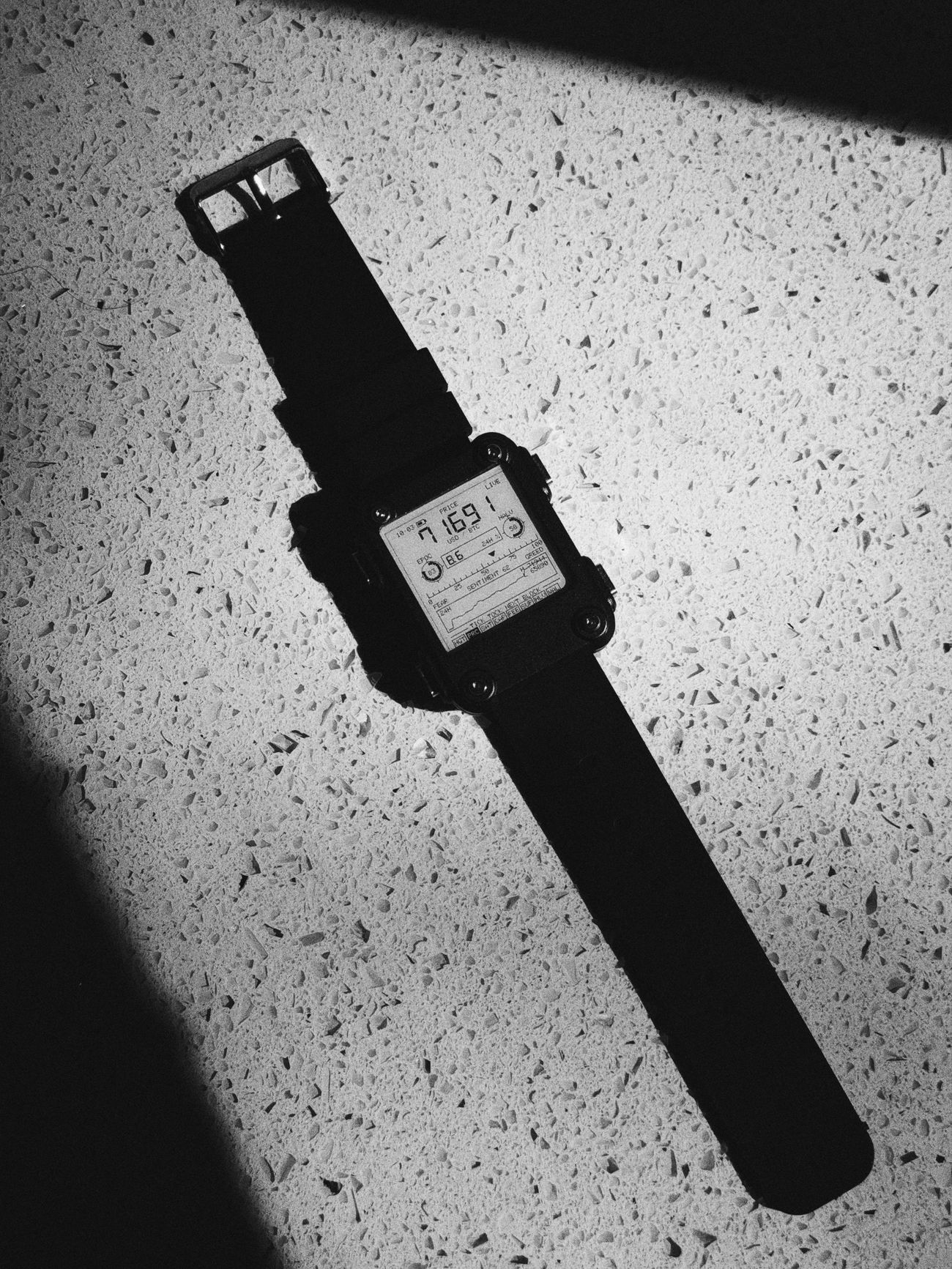
- HGTblock height, with the last block's reward, the pool that found it, the retarget estimate, the chain's measured minutes per block, how long the current block has stood, and the mempool backlog.
- PRCprice, in six currencies.
- SATsatoshis per unit of fiat, with Moscow Time in the box.
- CAPmarket capitalisation, and what share of gold's it has taken.
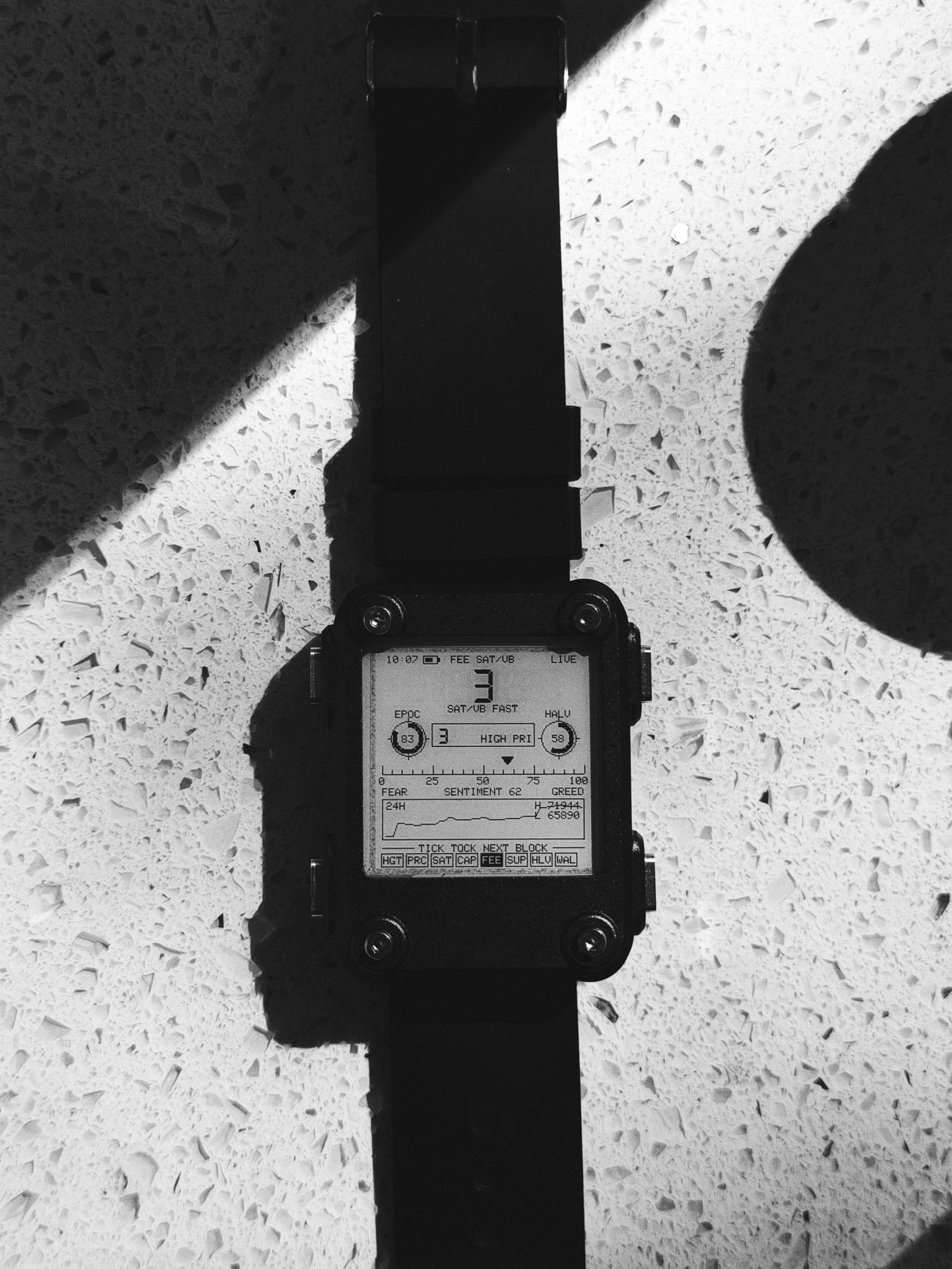
- FEEsat/vB at high, medium and low priority, to two decimals — a quiet mempool runs below one sat per byte, and 0.25 is not 0.
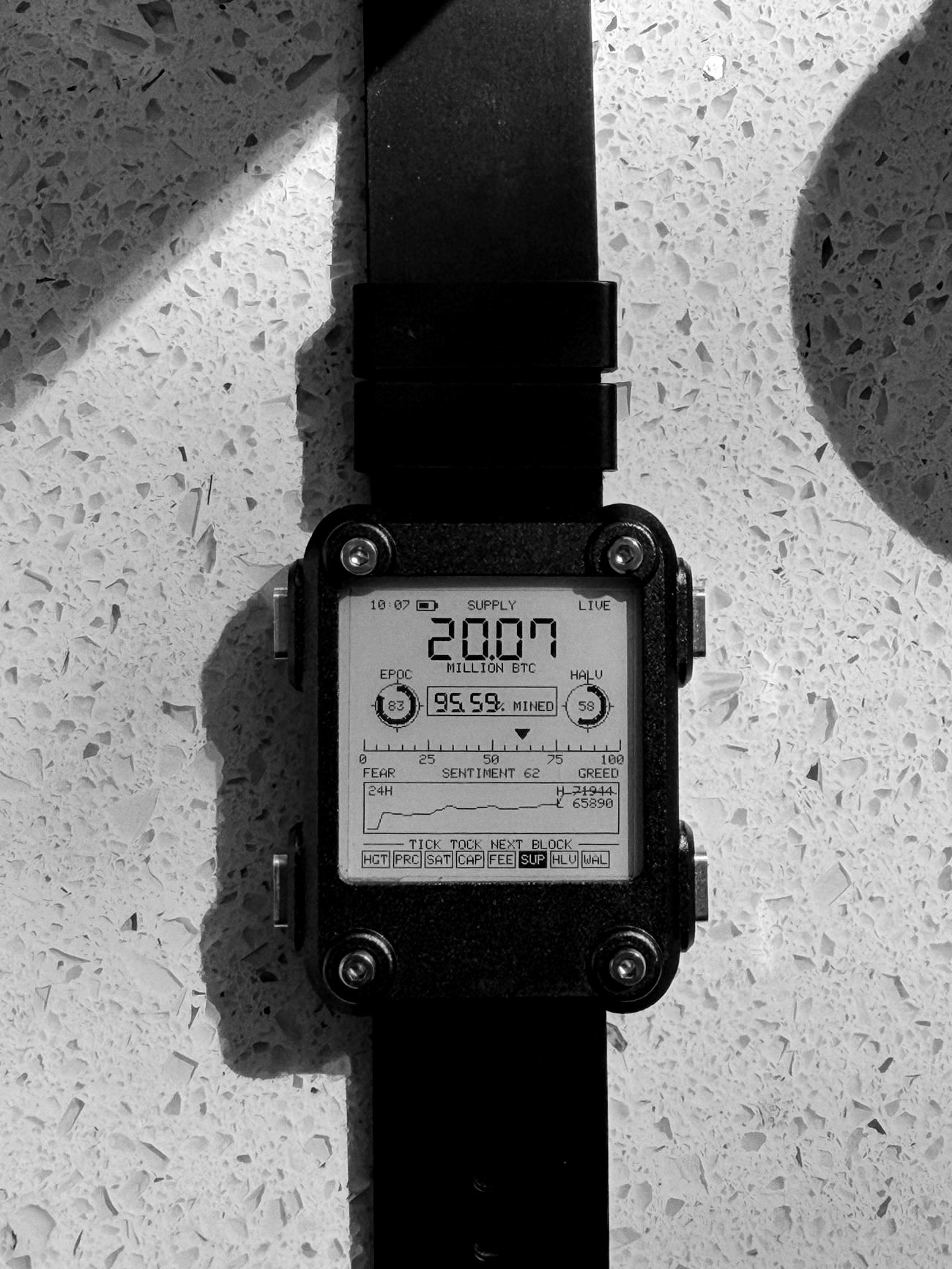
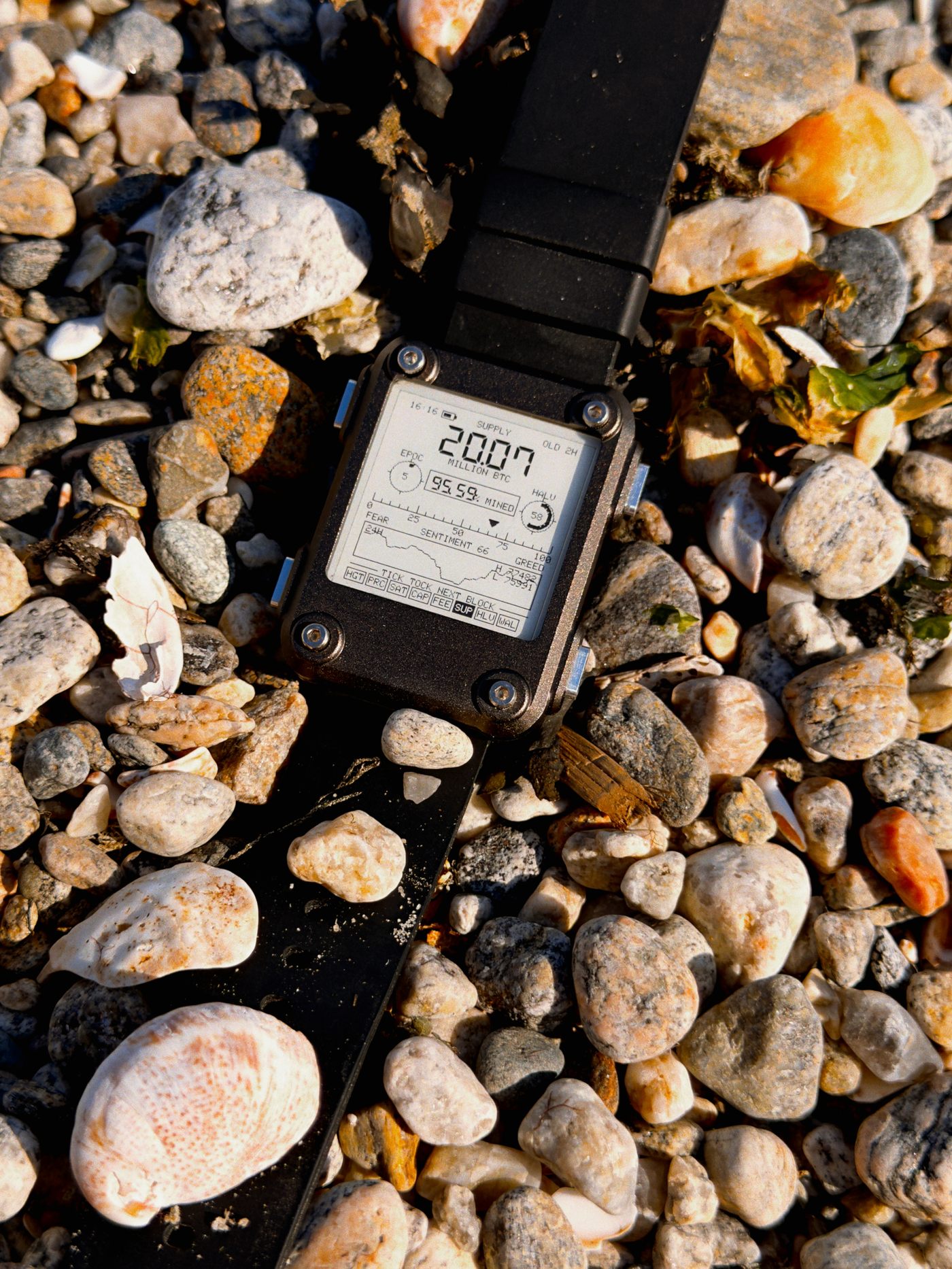
- SUPevery coin issued and every coin still to come, to the hundredth, derived on-device — one climbing, one falling, both stepping on each block.
- HLVthe halving almanac: dates and subsidies for the next six halvings.
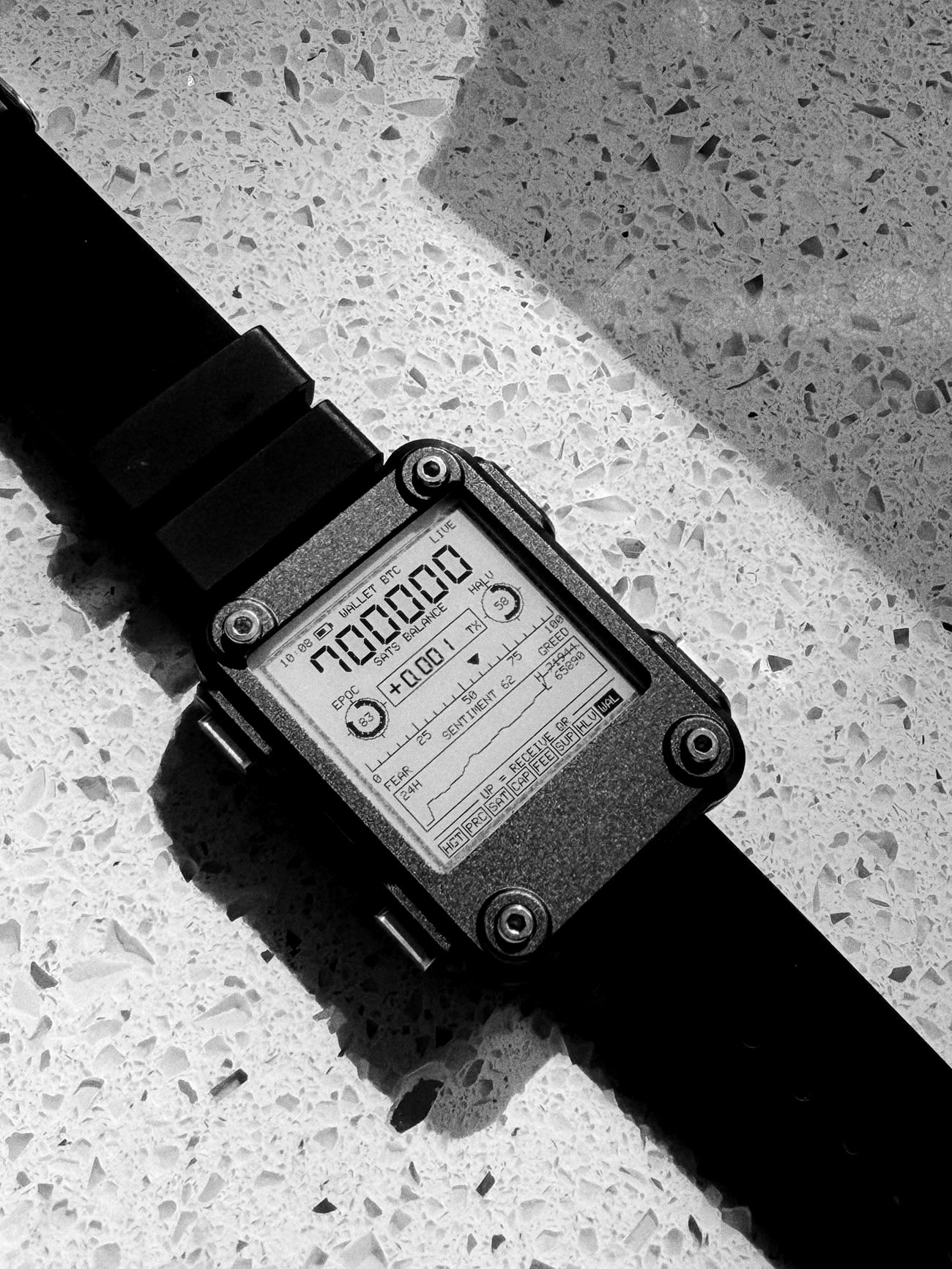
- WALbalance, receive QR, Lightning QR, and the last payment received. Hold DOWN to hide the numbers.
- JOEtime, day, date. Nothing else — for when you would rather not be asked what you are wearing.
The grammar is deliberately small. MODE selects the instrument, UP turns its crown. Every reading is live, computed on-device, or explicitly labelled stale. The watch never displays a number it cannot defend.
Instructions The manual — every mode, every button, in six minutes
Claims
Measured, not promised.
- Block height
- On a network the height is exact — fetched, not inferred, and refreshed every fifteen minutes. Off it, the watch falls back to dead reckoning: it counts forward at the epoch's measured block time, and the face stops claiming to know the tip — the unit line becomes an estimate with its own error bar, EST +36 BLK +/-6 after six hours offline. Blocks arrive as a Poisson process, so the uncertainty grows as the square root of the blocks estimated: six hours of guessing is thirty-six blocks and about six of error, a full day is one hundred and forty-four blocks and about twelve. The watch would rather show you the size of its ignorance than a confident number that is quietly wrong.
- Payment detection
- Press UP in wallet mode and the receive QR appears — a watch-only wallet cannot spend, but it can be paid. The watch then stands watch for two minutes, polling the address it just showed, and buzzes the moment sats land. This works even in a parking lot at 1.3% battery.
- Lightning
- LNURL-enabled: press UP again and the watch requests an invoice from your Lightning address, renders it, and polls for settlement. Where the provider supports LNURL-verify it buzzes three times within seconds of being paid.
- Supply
- Computed on the watch from block height alone. No API is involved; the height is the calendar.
- Privacy
- Hold DOWN in wallet mode and the balance and last payment go behind dashes. The receive QR still works — being paid is not the private part.
- Clock
- v3 has no dedicated real-time clock, just the ESP32 and a crystal, and it ran about three minutes fast a day. The watch now re-anchors to network time every six hours on the back of a fetch it was making anyway, so the error stays under a minute.
- Keys
- Watch-only, from a zpub. It derives addresses; it cannot sign. Losing the watch loses nothing.
Editions
Two editions.
Both made to order.
Both are open now. Genesis 21 is twenty-one units in orange anodised aluminium, machined and finished in a single batch, numbered 1 to 21; each caseback is engraved with its number and the block that confirmed its payment, so every watch is a timestamp of its own purchase. When the twenty-one are gone they are gone. The standard edition is natural bead-blasted aluminium, unnumbered, running the same firmware and carrying the same instrument.
- Genesis 21 — 1,000,000 sats
- Orange anodised, numbered, block-engraved caseback. Twenty-one units, then never again. Three weeks lead time.
- Standard edition — 500,000 sats
- Natural bead-blasted aluminium, unnumbered. Built in batches as orders come in. Four to six weeks lead time.
Reserve a number at hello@btctech.xyz.
Nothing is held in stock. Each watch is assembled, flashed and field-verified by hand after it is paid for. Pure proof of work.
Priced in satoshis, paid in bitcoin, on-chain or over Lightning. No cards, no accounts, no custodian.
Specifications
- Case
- Armadillonium CNC aluminium, bead-blasted. 40.40 × 50.35 × 14.55 mm. Four M2 hex socket fasteners, counterbored. 22 mm lugs.
- Display
- 200 × 200 one-bit e-paper, 27.6 mm active. No backlight. Holds its image with the power off.
- Platform
- Watchy by SQFMI, open hardware. ESP32-S3, WiFi, RTC, accelerometer.
- Timekeeping
- RTC disciplined by NTP every six hours. Block height is fetched, never inferred, while the network is reachable.
- Haptics
- One tick per block. Two quick pulses for a $1,000 rise, one long for a fall.
- Battery
- Multi-day on the wrist, deep sleep between minutes. Always awake when docked.
- Data
- mempool.space, blockstream.info, Coinbase market data, alternative.me — or your own node.
- Setup
- From your phone, through the watch's own WiFi portal. Three networks remembered and roamed. No app, no account, no mailing list.
- Water resistance
- Rain proof, not swim proof. It is, however, fully fiat-proof.
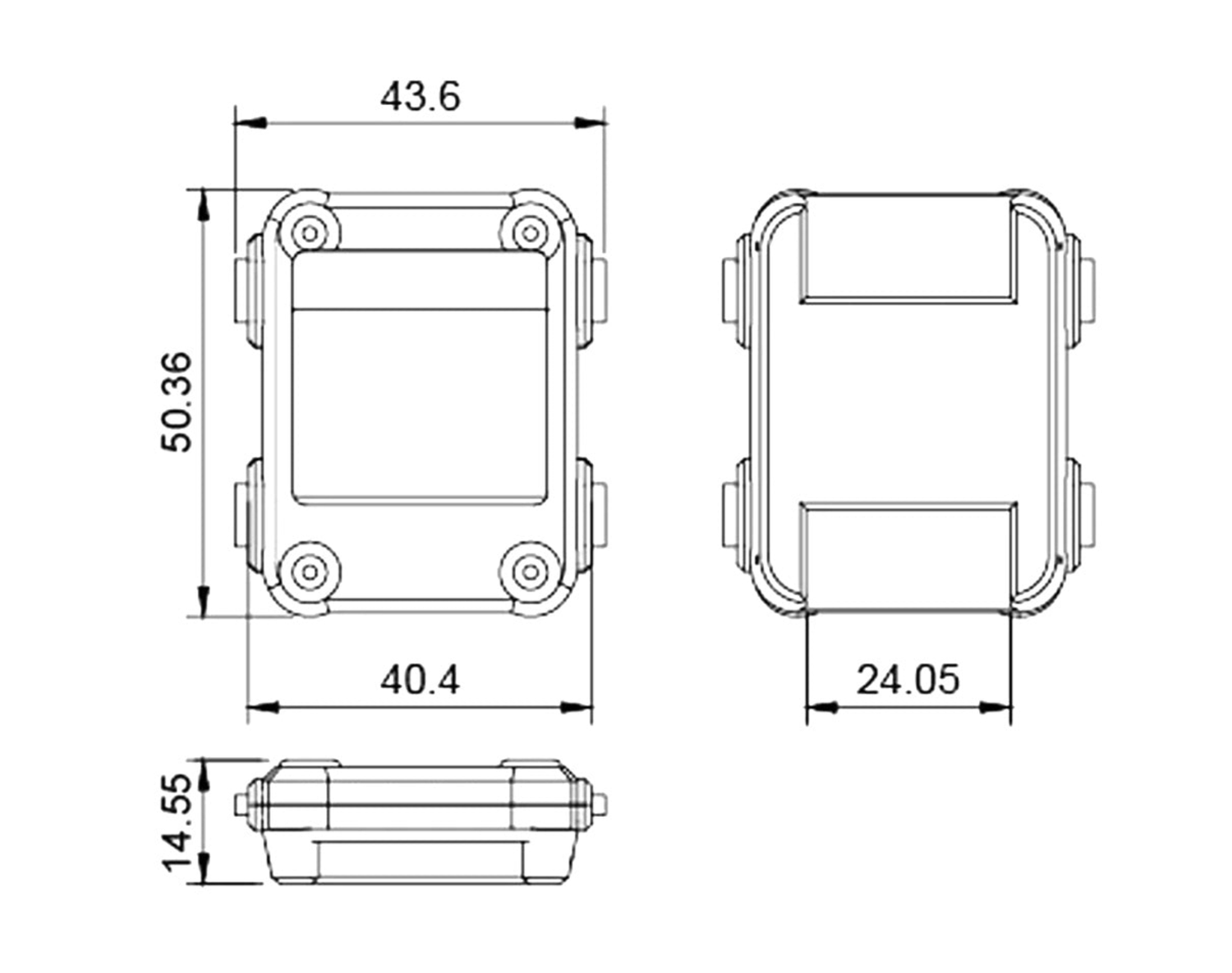
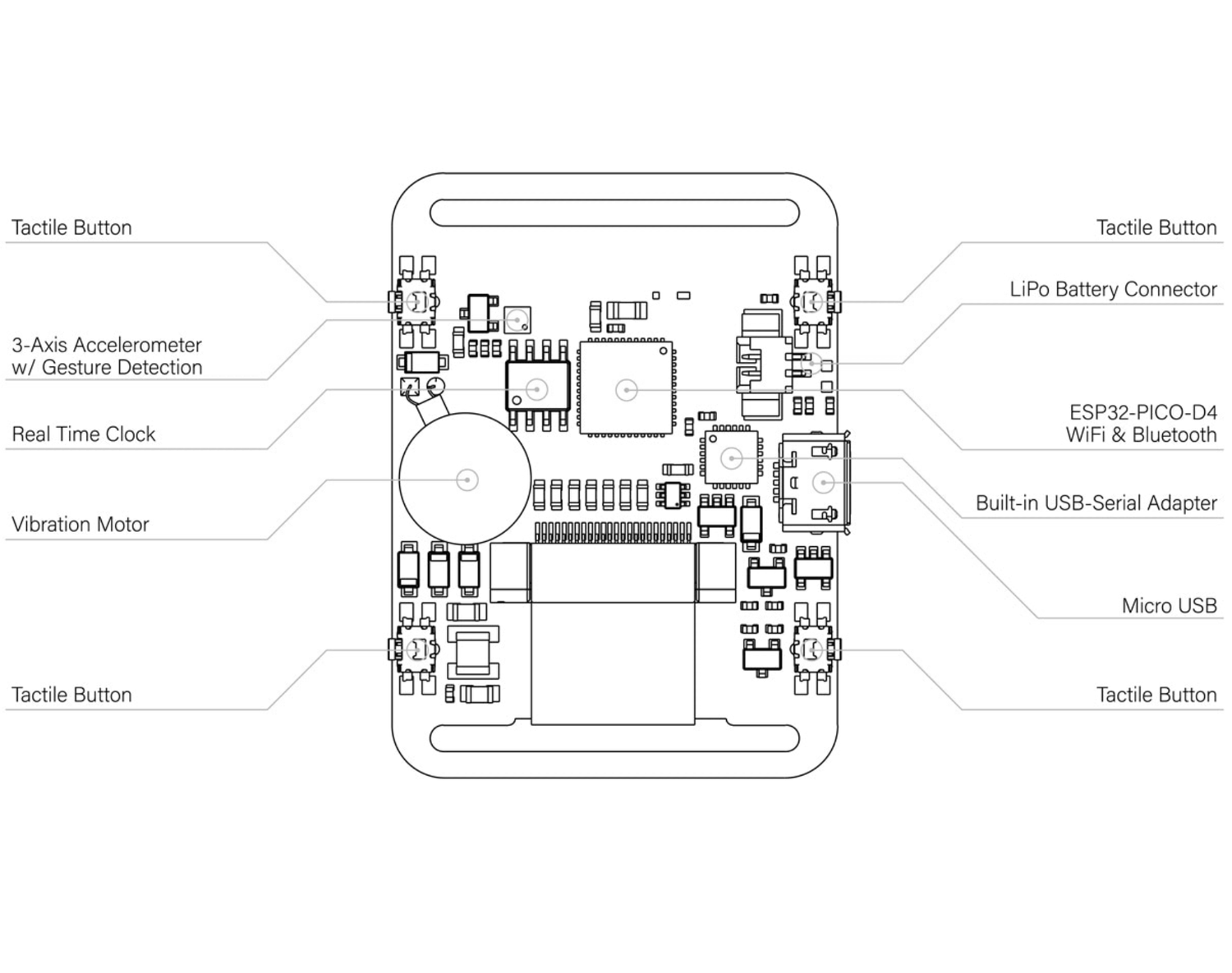
Drawings by SQFMI, from the Watchy open-hardware documentation, reproduced under its licence.
Field log
Twenty-five faults,
all found by wearing it.
None of these appeared on a bench. Each one turned up in ordinary use — on a wrist, in a parking lot, halfway through a purchase — which is the argument for wearing a thing you intend to sell. A product page that only lists features is hiding something, so here are five, in plain terms.
The shore
Shell money, and a chain
that doesn't need you.
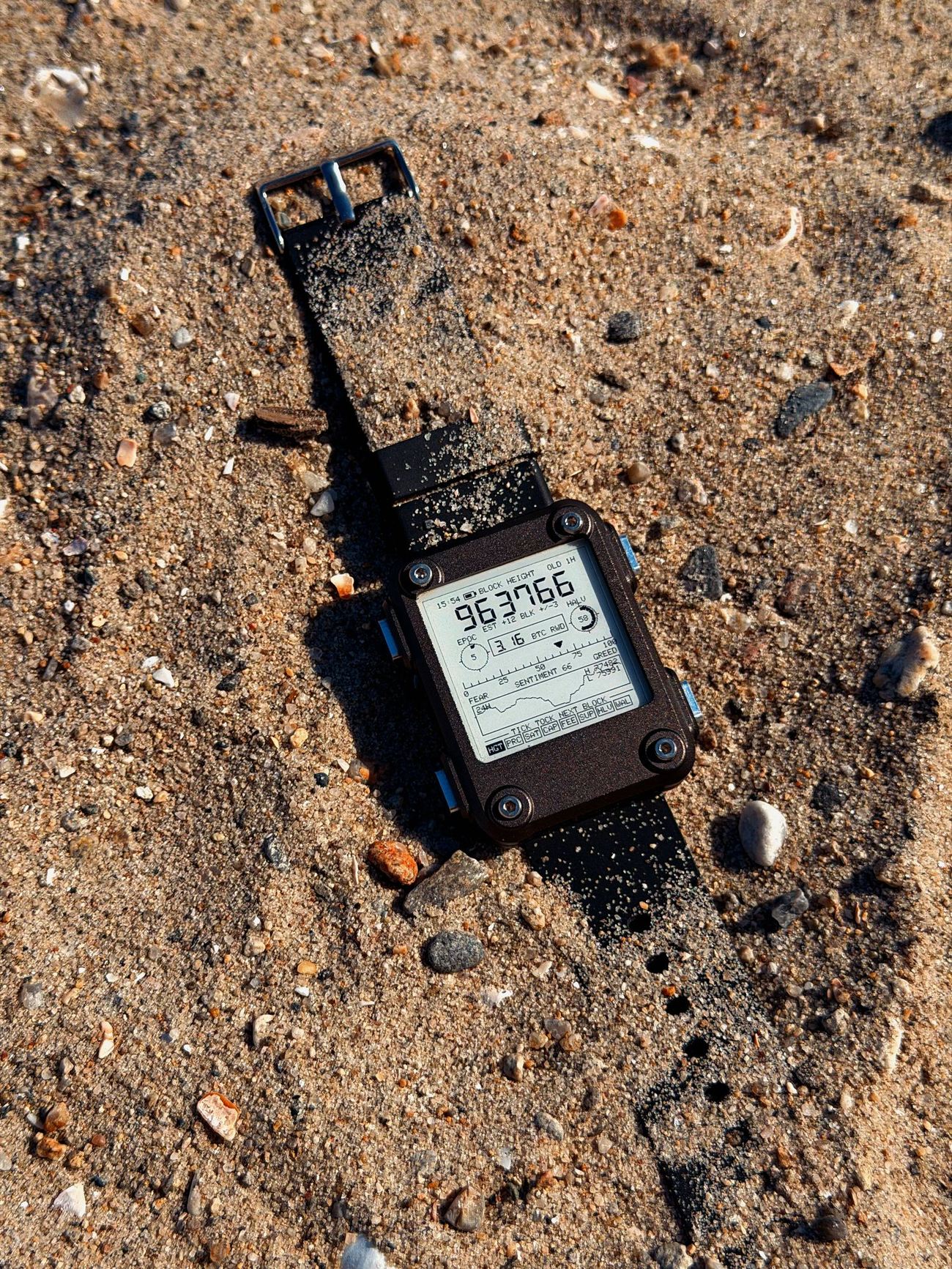
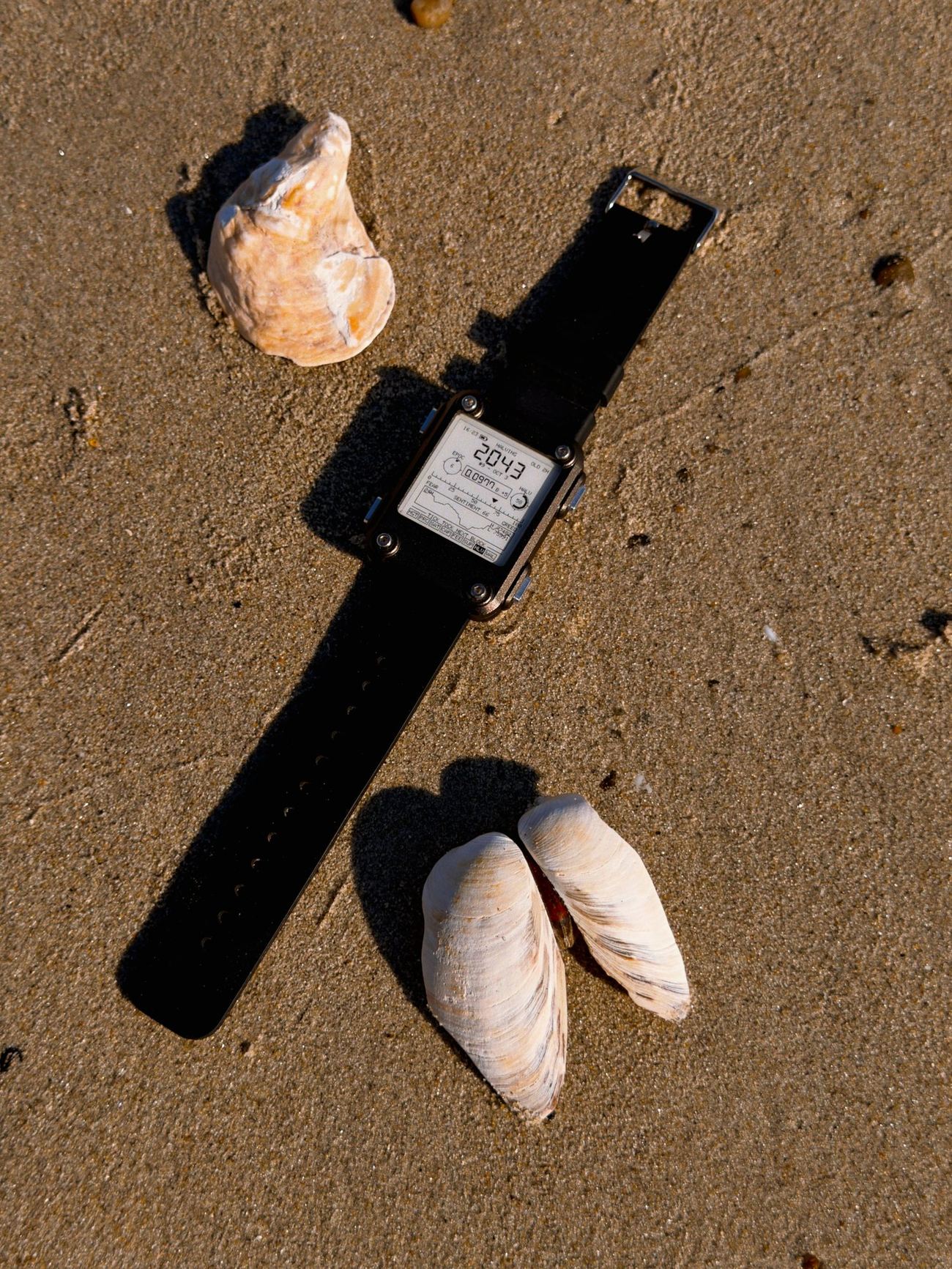
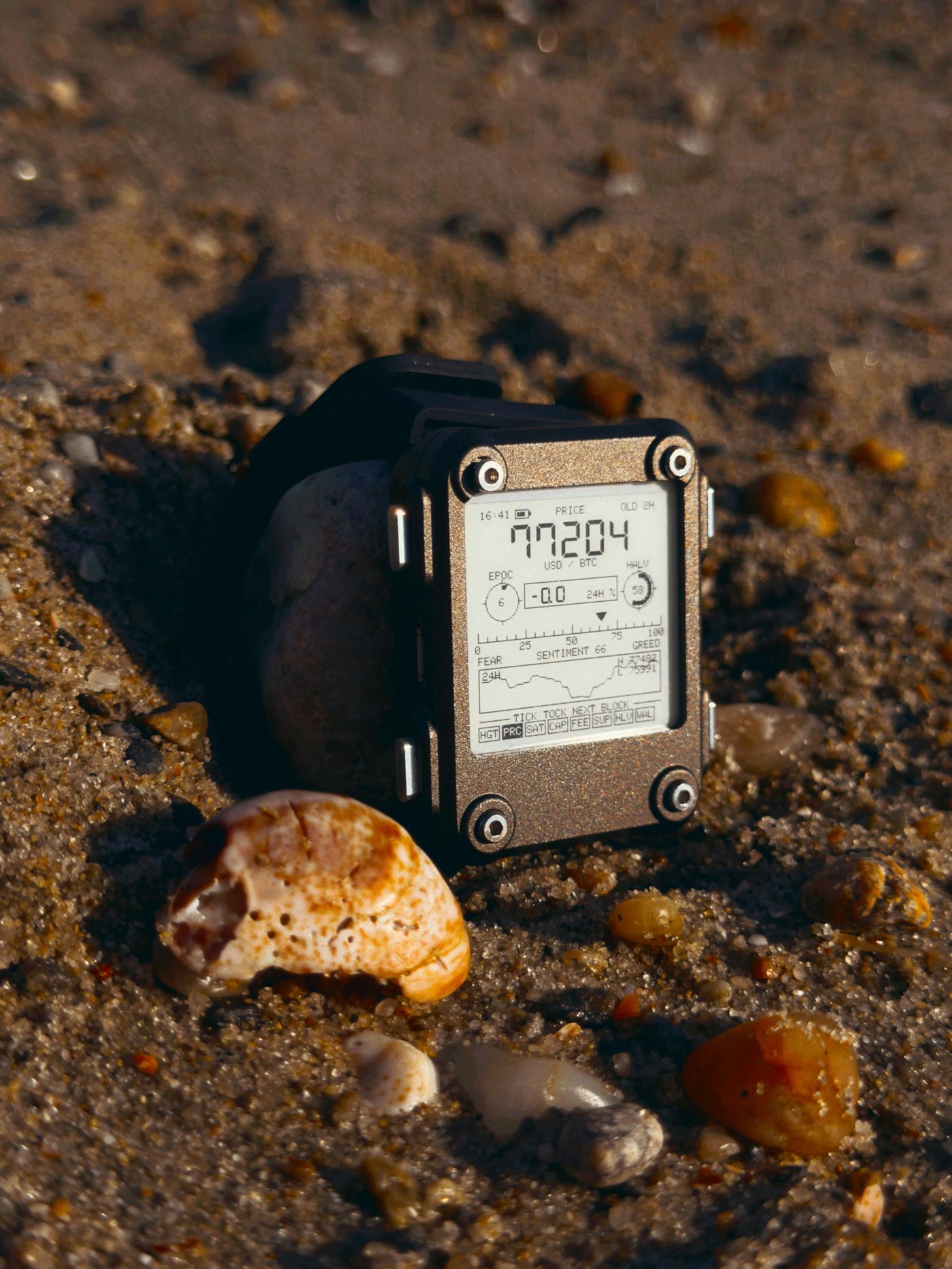
An afternoon at the tideline, because a watch that only ever appears on a countertop is a watch nobody has actually used. Shells were money long before coins were: valuable while they were hard to gather, worthless once they weren't. The sand is the other half of the argument — the chain keeps counting whether the instrument is on a wrist, in a drawer, or half-buried and ignored.
Colophon
BWATCH bw–1 is DIV-001 of BTC Technologies, a conglomerate of one. Built on Watchy by SQFMI. Inspired by Bitcoin is Time. Data by mempool.space. Drawings generated from the machined part; see the viewer.
Firmware and this page are MIT licensed. Build your own: everything is on GitHub, free, forever. The editions are for people who would rather have one made.
No cookies, no trackers, no accounts. This page is one hand-written file.